The cell phone in bed seems like a harmless habit, but data gathered by the National Sleep Foundation reveals that nighttime exposure to the blue light emitted by smartphones directly interferes with the biological clock, suppresses the production of melatonin and reduces the depth of sleep. The immediate consequence is waking up with a feeling of fatigue, mental fog and less capacity for physical recovery.
Cell phone in bed: how blue light confuses the biological clock
The first piece of this physiological puzzle is blue light itself. When the eyes come into contact with the smartphone's light beam after dark, the retina sends the same message to the brain as it would during the day: there is still enough light to stay awake. According to the study cited, this stimulus causes the suprachiasmatic nucleus – the region responsible for the circadian rhythm – to postpone the command to start the metabolic shutdown process. Therefore, instead of preparing the organism for the nocturnal cycle, the visual signal artificially prolongs the state of wakefulness.
This delay has a ripple effect. The natural peak of cell recovery, normally scheduled to occur in the early hours of the night, is also postponed. When the body finally achieves a few minutes of deep rest, there is no longer enough time to complete all the restorative stages before the alarm clock goes off.
Cellphones in bed and the hormonal cascade: melatonin under attack
The second critical point involves melatonin, a hormone that tells the body that it is time to sleep. The National Sleep Foundation detected that, right from the initial exposure, blue light suppresses the release of this substance into the bloodstream. Without this chemical signaling, the body remains in alert mode, even if the person is physically lying down. The delayed production of melatonin hinders the gradual decrease in body temperature and the reduction in heart rate, two essential indicators for the transition to deep sleep.
The metabolic comparison table reproduced below in the original source shows how this hormonal blockade affects the entire architecture of rest:
With screens in bed: inhibition and delay of melatonin, short cycles of deep sleep and a state of continuous hypervigilance.
Early disconnection: stable hormonal levels, long cyclical periods of deep sleep and progressive relaxation.
Cell phone in bed: dopamine, hyperalertness and micro-arousals
In addition to the light pathway, there is the behavioral component. The act of scrolling through your social media feed distributes small dopaminergic rewards that keep the prefrontal cortex hyperstimulated. This stimulation makes cognitive shutdown difficult, extending the state of alert beyond what is necessary. The study describes that the combination of blue light and emotional arousal leads to a fragmentation of the sleep cycle. Even if the user doesn't realize it, micro-awakenings occur that break the continuity of the deepest stage, responsible for muscular, immunological and mental restoration.
The practical result manifests itself in the morning: tiredness, difficulty concentrating and the feeling that rest was not enough. This situation does not result from less time in bed, but from less efficiency in the N3 and REM stages, precisely the first to be sacrificed when the brain is kept on alert.
Cell phone in bed versus previous disconnection: complete metabolic comparison
To measure the differences, the study contrasted two routines. In the first, participants remained connected to their cell phone in bed until it was time to turn off the lights; on the second, they turned off all devices at least 60 minutes before bedtime. Laboratory results indicated:
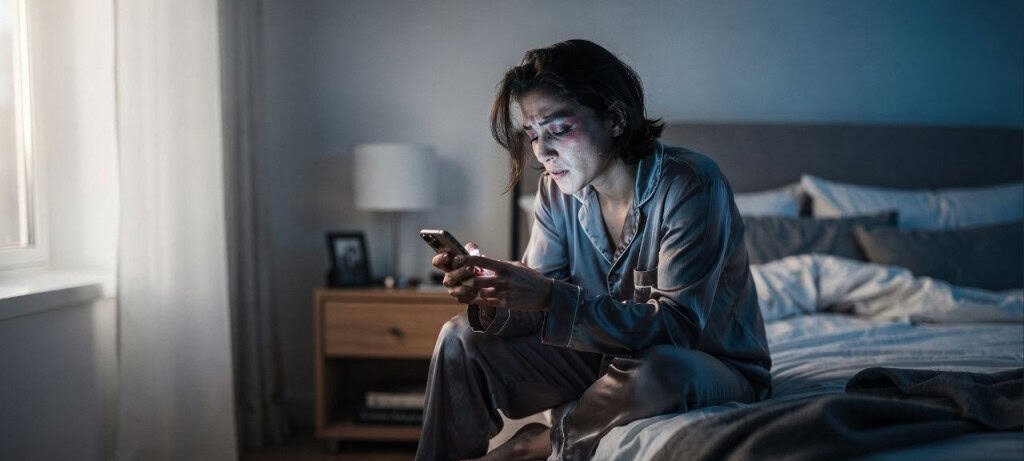
Image: artificial intelligence
Melatonin: significant drop and delayed peak in the connected group; stability in the disconnected group.
Deep sleep: reduced, fragmented periods versus long, continuous cycles.
Alertness level: maintenance of signs of hypervigilance (high temperature and heart rate) versus gradual reduction of these markers.
These findings explain why many individuals report waking up “exhausted” even after a theoretical eight hours of rest: the quality of sleep, and not just the quantity, was impaired.
Cellphones in bed: practical strategies to reverse the damage
The investigated source suggests a central measure: turn off all electronic devices 60 minutes before your scheduled bedtime. This interval is enough for melatonin to resume its natural course and for dopamine levels to return to baseline. During the same period, low-stimulation activities — such as reading a physical book or practicing meditation — send the opposite signal to the brain, reinforcing the idea that rest is approaching.
Another recommended adjustment involves sleep hygiene: keeping the room dark, quiet and at a cool temperature. The absence of light stimuli complements the reestablishment of the circadian rhythm, while silence reduces the chance of micro-awakenings induced by sounds that the brain, in a state of digital hypervigilance, could amplify.
Cell phone in bed and the efficiency of rest: what to expect after changing your habit
The source shows that eliminating cell phones in bed increases total REM sleep time, a crucial step for consolidating memories and regulating emotions. When restoring this stage, the individual tends to notice a gain in mental clarity, greater physical disposition and reduced morning irritability. The expectation of improvement derives solely from the reversal of the documented effects: normalization of melatonin, decrease in alertness and return of complete cycles of deep sleep.
Finally, the guidance remains objective: replacing smartphone use with low-light and stimulating activities at least one hour before bed, combined with maintaining a dark and silent room, constitutes the most efficient and accessible strategy to restore balance to the biological clock.
Artigos Relacionados Expired licensing: understand why an overdue document can land your vehicle in the yard and weigh heavily on your pocket
 Smell of rain: understand the science behind the aroma that announces the storm
 Parade that honored Lula generates political reactions and actions in the TSE: understand all the developments
 Melhor época para visitar a Disney em 2026: guia completo de lotação, feriados e eventos
 Empreendedorismo digital materno: sete caminhos para mães gerarem renda trabalhando em casa