Lasar Segall returns to occupy a prominent place in São Paulo's cultural circuit with the exhibition “Lasar Segall: Always the Same Moon”, organized by the Jewish Museum in partnership with the Lasar Segall Museum. The starting point of the exhibition is the recovery of “Interior de Pobres II”, a 1921 painting that, after restoration, helps to recount the trajectory of the Lithuanian painter who lived in Brazil since 1923 and recognized as an exponent of modernism.
Lasar Segall: the Lithuanian painter's trajectory in Brazil
Residing in Brazilian territory two years after painting “Interior de Pobres II”, Lasar Segall found in the country an artistic scene open to modernist experiments, although some conservative critics rejected him as foreign and “degenerate”. In 1943, when he exhibited his paintings at the National Museum of Fine Arts, in Rio de Janeiro, he was the target of verbal attacks that highlighted the strangeness of his innovative aesthetics. The negative reaction, however, did not prevent Segall from continuing to explore themes linked to conflicts, migration and social inequalities, experiences influenced by his condition as a Jew in a Europe marked by anti-Semitism and, later, by his immigrant status on Brazilian soil.
Segall's career extended until 1954, the year of his death, a period in which he developed a varied production that ranged from intimate portraits, urban scenes, tropical landscapes and blunt representations of war violence. The current exhibition aims to present this set of phases to the public, reinforcing the artist's commitment to the dignity of marginalized groups.
Lasar Segall and the portrayal of post-World War I poverty in “Interior de Pobres II”
The visitor is welcomed by “Interior de Pobres II”, a work that summarizes the painter’s vision of impoverished Germany after the First World War. The painting brings together four figures in a small room, each isolated in their thoughts. Two men and a woman remain sitting in the corners; the fourth character, of undefined gender, sleeps exhausted on a sofa, sporting purple eyelids that suggest illness.
The scene, dominated by earthy and gray tones, reflects the despondency of a society recently devastated by war and economic crisis. The elongated shape of the faces, Segall's signature feature, shares space with austere brushstrokes, emphasizing the state of introspection of those present. The painting, which was torn up and stored in technical reserve, was restored thanks to a joint program between the two museums involved in the exhibition. Back to the public, it marks not only a feat of conservation, but also a recovery of memory about the impact of the war on the poorest classes.
Nazi persecution and the classification of “degenerate art” — impact on Lasar Segall
Next to the opening screen is “Eternal Walkers”. The composition, confiscated in 1933 from the Dresden City Museum by the Nazi dictatorship, was branded an example of “degenerate art”. In it, five angular figures advance in a dark environment, representing people forced to abandon their homes to escape persecution. The painting disappeared for decades until it was discovered in 1954, in the attic of a former German officer, by a French dealer.
The episode illustrates a chapter of censorship that affected several artists, including Segall, whose work was associated with views contrary to the totalitarian regime. The seizure of the work reinforces the context of intolerance that the painter experienced in Europe and explains his attention to migrants, refugees and victims of discrimination. This interest is present in a series of drawings produced during the Second World War, in which he recorded scenes of violence, as in the study entitled “Pogrom”, from 1937, which shows bodies piled up on rubble.
Lasar Segall on the Rio scene: the Mangue and the dignity of female workers
After settling in Brazil, Lasar Segall turned his attention to urban Brazilian realities. In Rio de Janeiro's Mangue — a marginalized area known for the presence of prostitution — he sought to portray the daily lives of women who lived in or circulated through the narrow streets. Paintings such as “Rua de Erradias” and “Figure with Reposteiro”, both present in the exhibition, show women with bare torsos walking or peering through the windows of shacks.
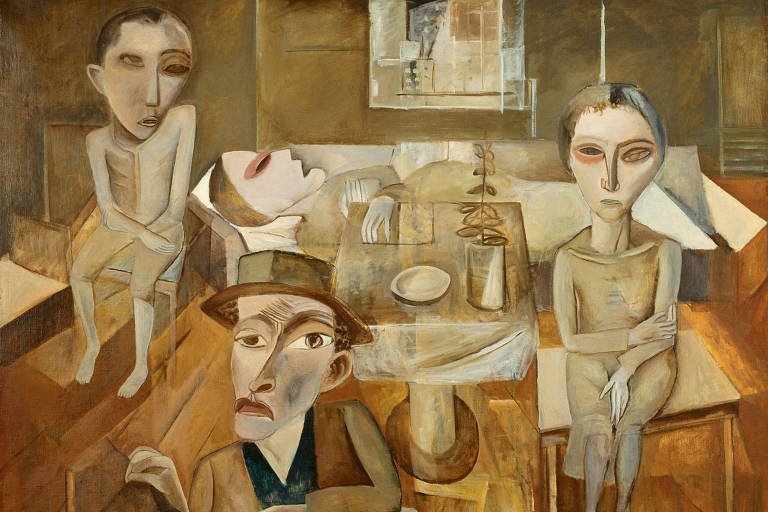
Image: Internet
Through these scenes, the artist sought to record, without moral judgment, the social condition that pushed those characters towards stigmatized activities. Curator Patrícia Wagner observes that Segall's empathy has roots in his own experience of exclusion, first as a Jew on European soil and, later, as an immigrant on Brazilian territory. By portraying these female figures, he sought to grant visibility and humanity to subjects on the margins of society.
Chromatic evolution: how tropical light redefined Lasar Segall
Experience with Brazil's intense light changed Lasar Segall's palette. If European works such as “Interior de Pobres II” favor ochers and grays, in paintings created in the country, brighter colors appear. “Morro Vermelho”, belonging to a private collection and rarely exhibited, exemplifies this phase. In the composition, a black woman carries a baby while a scene of cheerful hues that combines sky, vegetation and urban construction spreads around her.
By choosing tropical light as the determining element, Segall increased the contrast between socially critical content and warm colors, creating readings that oscillate between denunciation and vitality. Even in the face of conservative criticism, the chromatic choice was part of his aesthetic statement in the Brazilian modernist environment.
Until the Moon remains the same: the exhibition “Lasar Segall: Always the Same Moon”
The current exhibition also brings together intimate portraits of people close to the painter. The wife, writer Jenny Klabin Segall, appears in different phases, reinforcing both the couple's emotional bond and creative dialogue. Jenny, who would later assume a fundamental role in documenting her husband's work and creating the museum that bears his surname, is accompanied by other frequent models, such as Lucy Ferreira, the artist's student, and Mira Perlov.
In his final years, the painter dedicated himself to rural and night scenes. “Floresta com Galhos Entrelaçados” and “Gado ao Luar”, both included in the exhibition, show anonymous cows resting under the soft light of the Moon — a star that, as reported in a letter to the poet Vinicius de Moraes, would be “always the same”, regardless of wars or human displacement. This transition of focus, from human drama to rural serenity, suggests a desire for respite after decades of tension-filled themes.
“Lasar Segall: Always the Same Moon” remains open to the public until April 5th. Visits can be made from Tuesday to Sunday, from 10 am to 6 pm, at the Jewish Museum building, located at Rua Martinho Prado, 128, central region of São Paulo. Tickets cost R$24, and classification is free.
Artigos Relacionados American Dad! returns to Fox: see schedules and all the highlights of Sunday's TV schedule
 Final da 4ª temporada de The Morning Show redefine o futuro de Alex Levy e deixa o destino de Bradley em aberto
 15 séries para fãs de Supernatural: horror, ação e mitologia em novas jornadas televisivas
 CBS detalha finais de outono e hiato de 15 séries; novos episódios só a partir de fevereiro de 2026